What’s New?

Mental Wellness Spotlight: Resources for Youth & Families in New Jersey

Posted on August 28, 2024

Isaiah-Fudge-2024_5-cropped-web

Isaiah Fudge
ACNJ Director,
Positive Youth Development

Recently, an Annie E. Casey Foundation (AECF) blog post captured a snapshot of the nationwide mental health concerns of Generation Z (Gen Z). These are individuals born between 1997 and 2012. The post acknowledges that about 75% of mental illnesses develop between the ages of 10 and 24. They also note that 65% of people from this age group reported at least one mental wellness issue in 2021 and 2022, compared to 51% of Millennials, 29% of Gen Xers, and 14% of Boomers. In New Jersey, 8% of youth have anxiety, and 5 of every 1000 youths’ emergency visits are for self-harm. AECF ranks N.J. number 3 in the nation for child health. However, in economic well-being and in family and community–two areas not always measured as factors contributing to mental wellness–N.J. ranks much lower. But there are resources available to support youth and families. Below is a list of some initiatives that can be accessed to combat mental health crises they may be experiencing.

Mobile Response & Stabilization Services

Mobile Response and Stabilization Services (MRSS) provide on-call crisis intervention services 24/7, 365 days a year. The project is funded through the Department of Children and Families, and gives youth and families access to immediate behavioral or emotional crisis and de-escalation services without needing to navigate several systems. However, in order to receive help, a youth between 18-21, or the caregiver of a youth under the age of 18 must dial 1-877-652-7624 and interface with PerformCare (a system administrator contracted by New Jersey Children’s System of Care) for an initial assessment. Afterwards, calls will be routed to the local MRSS team nearest to the family. Services are provided within 1 hour of contact, and can be conducted in the youth’s home or over the phone. Following the immediate intervention, a follow-up assessment is conducted, with planning for stabilization and linkage to services rounding out the support. Learn more: Mobile Response Stabilization–Casey Family Programs

988 Helpline 

Funded through the Substance Abuse and Mental Health Services Administration (SAMHSA) and administered by Vibrant Emotional Health (Vibrant), the nationwide 988 helpline is a service people can utilize when experiencing emotional distress or a suicidal crisis. The line can be reached by the individual experiencing the crisis, or by someone on behalf of another individual. Trained Crisis Counselors are available 24/7 for confidential support. Learn more: https://njhopeline.com/what-we-do-2/

Blue World Mental Health Day Instagram Post (1)

2NDFLOOR

2NDFLOOR is a confidential and anonymous helpline for New Jersey's youth and young adults. The organization helps youth between the ages of 10-24  find solutions to the problems they face at any location they may be (home, school, work, etc.). Youth and young adults can receive support in areas including: cyberbullying, dating & relationships, sexuality & personal identity, substance use and misuse, and much more. To access services, youth and young adults can text or call 888-222-2228, or visit the 2NDFLOOR website and post to their message board.

Note: Messages posted on 2NDFLOOR’s website are NOT anonymous, and posters must be 13 years old or older. Learn more: 2NDFLOOR: Youth Helpline of New Jersey

Substance Abuse & High-Risk Intervention:

Bill S4250/A5326, the “Seabrook-Washington Community-Led Crisis Response Act” established legislation enabling community-led responses to non-violent mental health and substance abuse issues. Organizations such as Salvation and Social Justice in Trenton; Reimagining Justice, Inc. in Paterson, and Transformative Justice Initiative in Camden can be contacted for restorative healing work for youth and adults experiencing immediate substance abuse issues. Further, community based violence intervention and prevention (CBVIP) work reduces harm in communities without the consequences of arrest and incarceration. The high-risk intervention unit of the Newark Community Street Team in Newark responds to incidents of violence based on referrals from the community and law enforcement. Their responses include support for mental health related issues leading to violence. The NCST also has an overdose response unit. Referrals can be made through their hotline at 1-833-254-6278. Learn more at https://www.sandsj.org/ | Home - Reimagining Justice | https://www.newarkcommunitystreetteam.org/

Food Insecurity

New Jersey is ranked 26th in the nation in children’s economic well-being, with 13% of children living in poverty; 24% whose parents lack secure employment; and 35% living in households with a high-housing cost burden. All of these factors seem to lead to an increased food insecure child population. In 2020, 9% of N.J.’s children were estimated to be food insecure, but in 2021, that percentage increased to 9.8%. Lack of food can lead to poor mental health. When people experience hunger at any level, their attention can shift to focus solely on survival. Hunger is never an excuse for harmful or destructive decisions, but it does contextualize them. Fortunately, N.J. is rich with resources to combat food insecurity amongst families. Rutgers Against Hunger’s website lists food pantries in every county in New Jersey. Find your Local Food Pantry.

Did you know that many students are still not taking advantage of New Jersey’s free or reduced price school breakfast program?

Posted on August 23, 2024

Screenshot 2024-08-23 100538

By Keith Hadad
Staff Writer 

For more information on this topic, contact Keith at khadad@acnj.org.

Did You Know Blog Banner

Breakfast is one of the most important meals of the day, especially for growing children. This is why legislators and advocates have worked so hard to ensure that free and reduced-price breakfast is available at school to the state’s underprivileged children. In 2024, Governor Murphy expanded the eligibility range for free and discounted meals through the Federal School Breakfast program and the National School Lunch program to families that have an annual income of up to 224% of the federal poverty level (no more than $67,200 annual household income), which was the second time in just as many years that New Jersey has widened the limits of these qualifications. However, there are still too many students missing this essential start to a healthy, productive school day.

Making a habit of starting the day with a healthy meal can assist students with reaching higher test scores, concentrating better in class, and spending less time out sick or in the nurse’s office, away from their lessons. Ensuring that more students begin their school day with a nutritious breakfast has been a major focus of New Jersey. ACNJ worked with other partners through the  New Jersey Food for Thought Campaign to improve the state’s ranking from 46th in the 2010 fiscal year to 19th nationally in the 2018 fiscal year for its student participation, which led to the state reimbursing districts $105 million in funding. However, despite this positive trend, the school breakfast program is still under-utilized. According to data from the 2024 NJ Kids Count Pocket Guide, in 2023, there was only 58% participation in the free or reduced-price student breakfast program per every 100 kids who also participated in the school’s lunch program. 

In 2019, a state law went into effect requiring schools with at least 70% of students eligible for free or reduced-price meals to serve breakfast during the school day. Again, the eligible yearly income range has expanded since then, and according to Hunger Free NJ, there are 60,000 more kids in the state who are eligible in 2024. Despite this, there are still some major school breakfast underachievers in New Jersey.

One of the reasons for a lack of participation in the breakfast program is when schools serve the meal prior to classes–before many children are able to arrive on campus. This is why several districts in the state have adopted a breakfast after the bell approach, which serves the meal during regular classroom hours. Providing breakfast in class leads to better student participation and a greater chance that a child will have a successful and healthy school day. It’s a popular option that shows real results. According to ACNJ’s 2014 Food for Thought: Annual New Jersey School Breakfast Report, in the first four years of the breakfast after the bell program, the amount of low-income students eating breakfast at school between 2010 and 2014 jumped by 55%.

Stigma associated with needing a free meal and resistance from school leaders and faculty can also be big contributing factors to districts underperforming in the fight against student hunger. Some teachers and administrators might also not want to adopt this model out of a fear of losing instructional time. However, in 2012, the NJ Department of Education and NJ Department of Agriculture joined forces to mandate that schools should count breakfast in the classroom as instructional time, in recognition of how the meal positively impacts the development and performance of students.

Based on this guidance, some teachers have transformed breakfast time into a way to get students warmed up for a day full of learning and engagement. Many give their children tasks, problems to solve or other prompts to work on as they eat their meal and become more alert and awake. This breakfast not only prepares students for their lessons, it’s a part of them, too. For example, as mentioned in Hunger Free NJ’s Food for Thought:

The State of School Breakfast in New Jersey, 2018-19 School Year report, a 4th grade teacher, Zoe Coleman, states that when classroom breakfast was introduced, she gave her students math and science problems to solve as they ate. She said this made the children more energetic and eager to learn, and she didn’t have to send hungry students to the nurse for a snack to get through the morning anymore.

Schools that do not provide breakfast for their students miss out on beneficial financial support. At schools in high-poverty areas, breakfast can be covered by federal per-meal reimbursements, which transfers supplementary funds into school meals programs that could be used to enhance the food quality, rebuild or upgrade cafeterias and kitchens, hire new staff, and acquire better supplies and equipment. For example, the Food and Nutrition Service of the U.S. Department of Agriculture says that the high needs schools of the state can receive federal reimbursements of $2.84 per free breakfast and $2.54 for each reduced-price breakfast served in the 2024-2025 year. These funds could be instrumental in combating childhood hunger and even paying for the breakfast program itself.

School superintendents are looked up to as the leaders of their districts, so their understanding and valuing of the benefits of free and reduced-price breakfasts is often the key to making after the bell breakfast programs accessible in your area. Reaching out to your local superintendent with your concern for the needs of children who’d otherwise go to school hungry could make a world of a difference.

From reducing stress on families that struggle to put food on the table to tightening relationships between parents and schools, and most importantly, allowing for less students to learn while hungry, an entire community could benefit from this program. Speak to your district’s superintendent about the after the bell free and reduced-price breakfast program today and help disadvantaged kids gain the energy and nutrition they need and deserve to get the best out of their education. 

For more information, please refer to Hunger Free NJ’s School Meals for All.

Did you know the federal budget and tax policies impact early childhood?

Posted on August 14, 2024

sbennett-headshot-1

By Shadaya Bennett
Senior Legislative Analyst

For more information on this topic, contact Shadaya at sbennett@acnj.org.

Did You Know Blog Banner

Congress is currently developing the Federal Fiscal Year 2025 (FY2025) Budget and updating tax policies to meet revenue and expenditure obligations, ensuring the country and programs that serve its citizens continue operating in the years to come. These financial measures dictate how resources are distributed and shape the future of vital programs, including those that support early childhood development. Understanding the evolution of funding policies can equip stakeholders with the necessary information to advocate for measures that lay the foundation for children’s growth and success, ensuring they are sustained and adequately funded.

While “a nation's budget is a reflection of its priorities and values,” it is evident that state and federal investment in early childhood development, particularly for infants and toddlers, remains alarmingly low. Federal spending on children aged 0-3 accounted for only 1.66%, 1.52%, and 1.99% of total spending in fiscal years 2023, 2024, and 2025 (projected), respectively. The first three years of life are crucial for brain development and foundational for developing skills, yet public investments for provisions that impact children during this period are most lacking. Additionally, most families lack the resources to bridge the gap between public funding and actual needs underscoring the necessity for intentional investment in early childhood development.

Understanding the Federal Budget and Tax Policy Process

The federal budget must be passed by Congress and signed by the President by September 30th each year to ensure annual spending for the next fiscal year can begin on October 1st and avoid a government shutdown. As the process for formulating the FY2025 Budget is underway, there are questions about whether lawmakers will meet this constitutionally mandated deadline. Many predict Congress will pass a temporary spending bill, known as a continuing resolution, to maintain federal programs at current funding levels, allowing the government to continue operating without formal funding legislation.

In addition to the fiscal year budget, federal tax policies dictate tax funding provisions to operate the country and support programs and services that impact citizens. These policies outline how taxes are collected, determine tax rates, define taxable income, and specify tax credits and deductions for individuals and businesses. Each year, the Federal Administration develops tax proposals, which are introduced as a bill in Congress. This bill is reviewed, debated, and modified by both the House of Representatives and the Senate. After Congress agrees on the final bill, it is sent to the President to be signed into law. Throughout the process, stakeholder input, including from advocates, industry representatives, and the general public, ensures a range of perspectives are considered in shaping the nation’s tax policies.

Pending Funding Policies and Early Childhood Development

As Congress negotiates the annual budget and tax policies, several critical early childhood development measures are at stake. Federal support for these programs is essential, as lack of investment would significantly impact children's early learning, health, and access to vital resources necessary for their development and future success.

Examples of programs under consideration in budget and tax policy negotiations, including current or projected funding provisions, include: 

Child Care Development Block Grant (CCDBG):

  • Currently funded at $8.75 billion for FY2024, an increase of $725 million over FY2023.
  • Proposed amount in the House (of Representatives) FY2025 funding bill = $8.8 billion.
  • Proposed amount in the Senate FY2025 funding bill = $10.35 billion.

Head Start and Early Head Start:

  • Currently funded at $12.27 billion for FY2024, an increase of $275 million over FY2023.
  • Proposed amount in FY2025 funding bill = $12.3 billion.

Preschool Development Grant (PDG):

  • Currently funded at $315 million for FY2024, level funding from FY2023.
  • Proposed amount in FY2025 funding bill = $250 million.

 IDEA Grants for Infants and Toddlers:

  • Currently funded at $540 million for FY2024, level funding from FY2023.
  • Proposed amount in FY2025 funding bill = $540 million.

Maternal, Infant, and Early Childhood (MIECHV) Home Visiting

  • Funded for a five-year cycle at $434.7 million in 2023, the highest level of federal investment in over a decade.
  • The next funding reauthorization cycle is scheduled for 2027.

 Tax Credits that Benefit Children

  • The Child Tax Credit (CTC) provides direct funding to parents allowing them to afford expenses that are essential for children’s well-being.
  • The Child and Dependent Care Tax Credit (CDCTC) is the only tax credit that directly helps working parents offset the cost of child care.
  • There is a proposed Senate tax bill which includes expanding the CTC to help more families.

In closing, the federal budget and tax policy consist of more than just numbers—they signify our nation’s investment priorities and values. As debates and negotiations in Washington, D.C. continue, it is crucial that policy makers keep the needs of our youngest citizens at the forefront. Early childhood development is not merely an expenditure but an investment in our collective future. Nationwide advocacy efforts must persist, to push for funding policies that prioritize the well-being and development of all children, particularly during the critical first years of life.

In late July, advocates for early childhood development gathered at the Alliance For Early Success's State Fed Connects Meeting, gaining key insights from policy experts and congressional leaders. ACNJ brought these strategies to Capitol Hill, advocating for crucial investments in #early learning, #childcare, and family support programs in the #fy25budget.

For information on Congressional activity, including upcoming House and Senate sessions and access to pending legislation, visit https://www.congress.gov/.

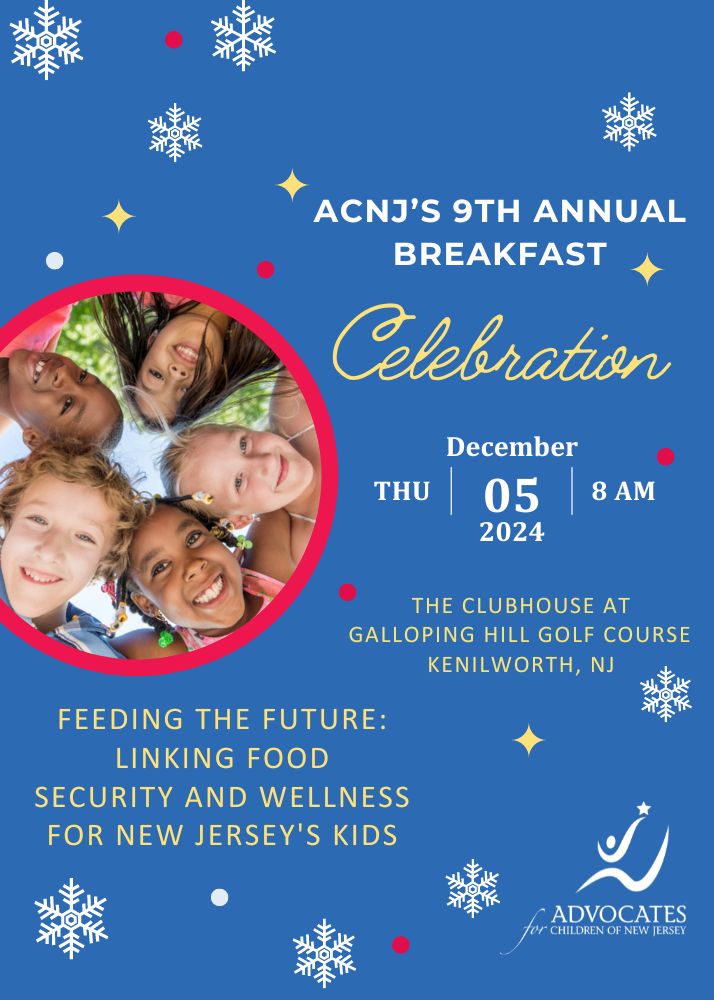
Join us for the ACNJ’s Annual Breakfast Celebration

Posted on August 13, 2024

We are excited to invite you to our 9th Annual Breakfast Celebration on Thursday, December 5th, at 8:00 a.m. at The Clubhouse at Galloping Hill Golf Course in Kenilworth, New Jersey. We look forward to seeing familiar faces and meeting new ones, and we hope you can join us!

This year's panel discussion, Feeding the Future: Linking Food Security and Wellness for New Jersey's Kids, will explore the connection between food insecurity and children's health. Featured panelists Elizabeth McCarthy, President and CEO of the Community FoodBank of New Jersey, and Mark Dinglasan, Executive Director of the New Jersey Office of the Food Security Advocate, will emphasize the vital role of proper nutrition in children's development and academic success. This discussion comes as the state has expanded the eligibility requirements for students to receive free school meals for the second time in two years.

Thanks to our many partners, we have much to celebrate. Their invaluable support has been instrumental in securing significant victories for children and families, maintaining ACNJ's independence, and promoting equitable opportunities for all of New Jersey's children. Despite political changes, budget challenges, and competing state priorities, we have remained a consistent and credible advocate for kids, and the contribution of our partners has been a key part of our success.

Please consider becoming an ACNJ Sponsor today. Sponsors will be recognized prominently, both online and in print.

Newark Kids Count 2024, A City Profile of Child Well-Being

Posted on August 8, 2024

NEWS: Latest Newark Kids Count Data Report, Now Available in Spanish, Reveals Mixed Progress in Outcomes for Child Well-Being

NEWARK, NJ – With fewer families living below the poverty line, a decrease in unemployment, and an increase in median household income, Newark is making progress in some areas of child well-being but losing ground in others, according to Advocates for Children of New Jersey’s (ACNJ) latest data book, Newark Kids Count 2024. Continue reading news release.