Posted on July 14, 2024
What’s New?

Education Spotlight: The Full-Service Community School Model’s Impact in Schools
Posted on July 8, 2024

Isaiah Fudge
ACNJ Director,
Positive Youth Development
Many issues in public education continue to persist. Among them are chronic absenteeism, student discipline, and teacher retention. Data quantifying these problems are alarming. As of the 2022-23 school year, New Jersey has a 16.6% chronic absenteeism rate, lower than many other states, but still strikingly high. Out-of-school suspensions—only one category related to student discipline—are up by 6,470 from 2021-22, with 44,261 suspensions reported across the state. Also, there were actually more full-time teachers reported for the 2022-23 school year than the 2013-14 school year, but the data shows gradual decline in teacher workforce in ELA (-8.37%) and Math (-7.97%). Additionally, 10% of total teachers exited the profession in 2022-23, compared to 7.4% in 2013-14.
In its recently released national Kids Count Data Book, the Annie E. Casey Foundation highlights the effectiveness of community schools—a potential answer to the issues named. Full Service Community Schools (FSCS) are traditional public schools that utilize resources from the community to improve the school climate and the well-being and success of students. Through a four-pillar system, FSCS in areas of New Jersey (such as Jersey City, Orange, Paterson, and Trenton) and many other states, positively impact the performance and well-being of students, their families, and their local communities. The FSCS model is most effective with legislation and/or proper funding and support. Further research shows the benefits this model has in crucial areas.
What are Full-Service Community Schools?
Full-Service Community Schools (FSCS) are traditional public schools that leverage resources from the community to improve student wellness and outcomes; to improve school climate and decrease staff burden; and to improve access and opportunity for the entire local community. Services in each school vary, as all FSCS reflect the distinctive needs of the communities they serve. Still, each school mobilizes critical resources from the community to improve students’ physical, mental, emotional, and academic wellness. FSCS are also designed to reprieve overburdened faculty, staff, and administration, and support the wellness of all people in the community. While each school is unique, all FSCS share four characteristics—the 4 pillars of the full-service model. They are:
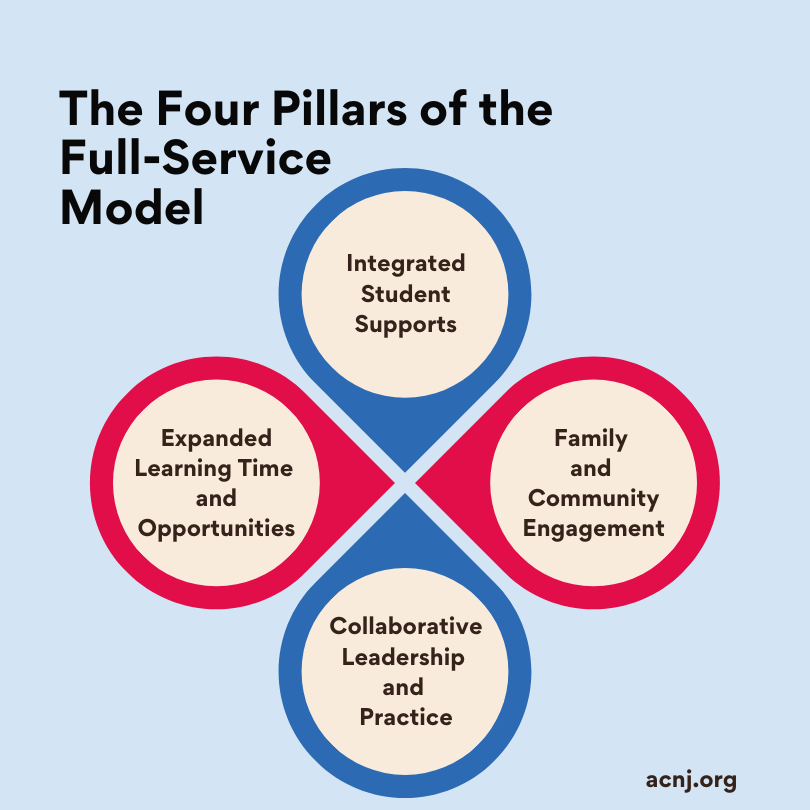
- Integrated student supports
Community schools provide a mix of different services that are specifically tailored to the particular needs of the students and families of their respective communities. A dedicated staff member coordinates customized supports with examples including health services; tutoring; parent education classes, job training and placement services; housing assistance; and nutrition programs. - Expanded learning time and opportunities
The schools provide increased access to after-school tutoring, physical activities, and experiential learning, all of which have lasting impact on students’ attendance, behavior, and achievement. Higher graduation rates, development of social, emotional, and leadership skills, and reduced involvement in systems are also residual effects of expanded learning time and opportunities. - Family and community engagement
When schools, parents, and communities engage, the bonds between them become stronger, schools become hubs, and the outcomes for students become greater. Schools improve when families participate in their programs, as they get to witness their conditions first hand. Parents become involved in decision making, and because of clearer understanding of the schools landscape, lend more support for their children’s education. - Collaborative leadership and practice
Collaborative leadership and practice involves shared decision making between teachers, administrators, students, staff, and families. It guarantees inclusive implementation, and creates shared ownership of the work. Local assets become more crucial because of the knowledge locals have about them, or because of the need they have for them. Schools become better equipped to serve the community when everyone is included in decision making; everyone works together in harmony and youth become more likely to succeed.
The Work of Full-Service Community Schools In and Around New Jersey:
In New Jersey, Jersey City Public Schools (JCPS), Orange Public Schools (OPS), Paterson Public Schools PPS), and Trenton Public Schools (TPS) have formal FSCS arrangements with any of the schools in their respective districts. Nonprofits including Mercer Street Friends (TPS), St. Paul’s Community Development Corporation (PPS), and Center for Supportive Schools (JCPS) lead work in their respective locations. State colleges have also gotten involved, with Montclair State University, The College of New Jersey, and others contributing to FSCS work across the state. Organizations like New Jersey Community Schools Coalition work to unite supporters and advocates of FSCS around its aid and expansion in the state. A school could be deploying all four pillars effectively, essentially making it a community school, even without state-level support.
Still, many schools in New Jersey school districts function similarly to a FSCS– they capitalize on teaming with local organizations. In New Brunswick, for instance, several schools partner with the local nonprofit, PRAB, to combat issues like low academic performance. In Camden, the Campbell’s Soup Company helps address students’ nutritional wellness through its Full Futures partnership. Several schools in Newark engage local resources like South Ward Promise Neighborhood and the Newark Community Street Team to combat chronic absenteeism and youth safety. Nationally, several states have FSCS in their Every Student Succeeds Act (ESSA) plan: Hawaii, Illinois, Maryland, Massachusetts, Minnesota, New Mexico, New York, Ohio, Pennsylvania, Tennessee, West Virginia, and Wisconsin. Additionally, in states like California, Colorado, Kentucky, Maine, Vermont, and Virginia, and in D.C., they have administrative, financial and/or legislative commitment to implementing FSCS, having established an “Office of Community Schools,” technical assistance centers, and/or other avenues supporting the model.
How are FSCS implemented?
The most effective FSCS receive sufficient funding and technical assistance. Funding allows for effective planning, hiring, asset coordination, and support for programmatic implementation. The Biden-Harris administration has consistently earmarked at least $75 million to fund FSCS nationally. States can support the model through competitive grants, entitlement funding, or supporting technical assistance centers. Effective FSCS show clear evidence of all four FSCS pillars, implementing them purposefully. The process starts with a thorough needs assessment, something that can be as simple as beginning to document recurring issues among students and their families in the community. This could be anything from violence intervention, to substance abuse issues, to food insecurity. The assessment is customized to that specific school’s needs. All school stakeholders—students, families, community members, teachers, administrators, staff—must be part of the initial needs assessment, in addition to thorough collection and examination of school data. Administrators coordinate with the local or national organizations that could address their school stakeholders’ needs, leveraging funding and/or legislation that supports the partnership. A lead partner—led by a Site Coordinator or Community School Director—coordinates all services within the school, collaborating on leadership items with school administrators, families, and other school stakeholders.
The Impact of FSCS
Research shows that the FSCS model positively impacts youth development. Nationally, the FSCS model increases safety, reduces chronic absenteeism, increases teacher retention, and boosts student academic performance, among other benefits. In 2019, 85% of students at Felicitas & Gonzalo Mendez High School in Los Angeles, California, reported feeling safe at school, 15 points higher than the national average. Hoover Elementary School in Cedar Rapids, Iowa, reduced referrals for disruptive behavior, and increased English Language Learners’ growth on language acquisition tests by 30 points in 2022-23. Many other national successes can be highlighted. In N.J., despite the few FSCS, there are data that highlight FSCS’ effectiveness in the state. In 2021, for example, Mahatma K. Gandhi School, PS #23 in Jersey City, reported an increase in school attendance by 10 points, to reach 90%--higher than the current state attendance rate of 83.4%--only three years after becoming a FSCS. That same school also retained 95% of its teachers for the 2022-23 school year, despite the state’s ongoing teacher shortage crisis. From 2011-2015, suspension rates at Paterson Public Schools’ Reverend Dr. Frank Napier Academy dipped by 17%. Since its inception in 2017 through 2019, chronic absenteeism decreased by 18% at Luis Munoz-Rivera Community Middle School in Trenton. Additionally, students saw a 13% increase in their average daily attendance rate from the 2020-21 school year to 2021-22 school year. The school-wide grade point average also increased 8%.
What's Next?
In January 2024, S2243 was introduced to the N.J. legislature. This bill would establish a five-year community schools pilot program in N.J. S2528—which would create an “Office of Community Schools” in N.J, and would appropriate $10,000,000 to do so—has also been introduced. It remains to be seen if this legislation will pass. If legislation isn’t passed, but funding is allocated, N.J. could see a rise in the amount of technical assistance provided to schools already doing FSCS work. This would drastically improve the effectiveness of some of the de facto work FSCS being done. Regardless, the FSCS model is worth further exploration, as it appears primed to catapult success.
Gov. Murphy Signs New Jersey’s FY 2025 Budget with Some Big Wins for Kids!
Posted on July 2, 2024
Highlights of State Budget Spending on Children and Families
The State Fiscal Year 2025 Budget was approved by the Legislature and signed into law by Governor Murphy before the June 30th deadline. The state budget, outlined in S2025-A4700, appropriates $56.6 billion in state funds and $27.5 billion in federal funds for resources, programs and services that will benefit New Jersey residents for the next fiscal year.
Advocates for Children of New Jersey engaged in the process, advocating for the need for various investments that benefit children and families. Below are key highlights.
Child Care
- $482.5 million for child care enrollment-based subsidy payments. This enrollment-based payment model provides a stable source of funding for providers who serve families receiving child care assistance.
Public Preschool Expansion
- $124 million to fund existing public pre-K programs
- $20 million in preschool expand aid for new districts
- Requires measures to deliver public preschool through a mixed delivery system including the following:
- School districts receiving Preschool Education Aid (PEA) for the first time must demonstrate efforts to establish partnerships with all willing and able licensed child care providers and Head Start programs in their communities or neighboring areas to provide preschool programs through mixed-delivery.
- School districts that demonstrate efforts to partner with licensed child care providers and Head Start programs will be given preference for grant funding.
- The New Jersey Department of Education, the Department of Children and Families, and the Department of Human Services must post lists of all school districts with state-funded preschool, districts eligible to apply for funding, and licensed child care providers and Head Start programs in each eligible district’s community and neighboring community.
K-12 Education
- $908 million in direct aid to schools, fully funding the school aid formula
- $3 million for the Community Schools Pilot Program Fund
- $7.2 million for literacy initiatives
- $1 million for the High Poverty School District Minority Teacher Recruitment Program
- $5 million for Teachers Loan Redemption Program
Child Tax Credit
- Maintains expansion of the Child and Dependent Care Tax Credit, and the Child Tax Credit which enables families with young children to receive up to $1,000 per child.
Hunger and Food Insecurity
- $318 million for the WIC Supplemental Food Program
- $8.2 million for the WIC Farmers' Market Nutrition Program
- $7 million for SNAP and School Meals Dual Enrollment Pilot Program
- $924.5 million for School Breakfast and Lunch Programs
Maternal and Child Health
- $23 million for Statewide Universal Newborn Home Nurse Visitation Program
- $3 million for the Statewide Maternal Health Innovation Program
- $3.2 million for the Maternal and Infant Health Innovation Authority
- Funding for medical coverage for uninsured families
Mental Health
- $30 million to expand the mental health workforce and provide services for children and adolescents
Positive Youth Development and Other Supports
- $43 million for the NJ Statewide Student Support Services Network (NJ4S)
- $8 million for anti-violence out of school youth summer programs
- $1.5 million for Kids In Need of Defense (KIND) - Legal Services for Unaccompanied Minors
ACNJ will continue to provide post-budget updates as additional information becomes available. Stay tuned!
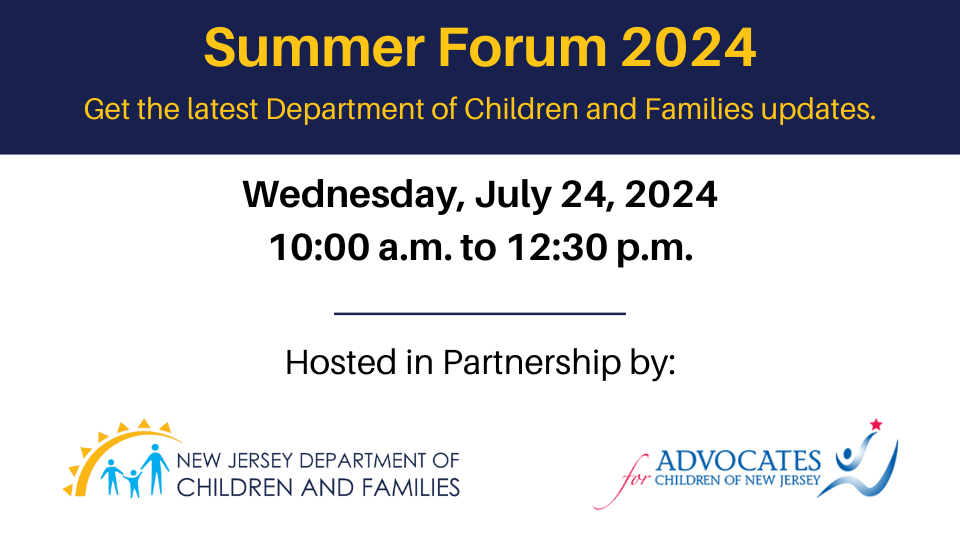
Register: 2024 ACNJ/NJ DCF Summer Forum
Posted on July 2, 2024
Get the latest news and events impacting children and families in the child welfare system. Join us in an upcoming webinar on the recently approved fiscal 2025 budget, DCF Strategic Plan update, Staffing and Oversight Review Subcommittee (SORS) and more.
Speakers:
Christine Beyer
Commissioner, Department of Children and Families
Mary Coogan,
President & CEO, Advocates for Children of New Jersey
Nydia Monagas,
Director of Training and Statewide Initiatives, New Jersey Children’s Alliance
Rebecca Bryan
Executive Director, DCF Office of Resilience
Brian Ross
Assistant Commissioner, Department of Children and Families
Joseph Pargola
Director of Policy, DCF Policy Oversight and Regulatory Affairs
Sanjna Shah, M.D.
Medical Advisor, NJ Department of Children and Families
Take Action: Urge Leaders in the Legislature to Support resolution A4365/S3301
Posted on June 25, 2024
Urge your leaders in the legislature to provide ALL New Jersey families the resources and services needed to successfully raise their children from before birth to adulthood.
Limited employment opportunities, insufficient and substandard housing, unsafe and unhealthy environments, inadequate and remote essential services – these overlapping conditions cultivate family distress and are prevalent in too many New Jersey communities.
Legislative bills A4365/S3301 invest in family success rather than focusing on the effects of distress, by providing support to ALL families and strengthening communities. Over four years in development, these bills direct state funding and programs to provide ALL families the resources and services needed to successfully raise their children from before birth to adulthood.
Please send a message TODAY to your state leaders in the NJ Legislature who can act now to move these bills forward.