What’s New?

A Father’s Day Letter to Aviv: They Will See You Were Here and You Were Counted #Census2020

Posted on June 19, 2020
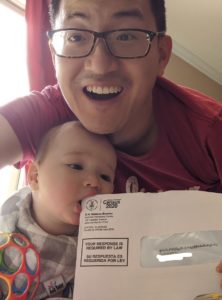
Policy Counsel Peter Chen and son Aviv.

Dear Aviv,

You can’t read this yet. By the time you can, the 2020 Census will be long over. I will be working on some different project or campaign at my job, moving towards a brighter future for New Jersey’s children, including you. You’ll be riding your bike or playing with friends. And you probably won’t be interested in what your dad worked on when you were a baby.

But your count in the 2020 Census will be just as important then as it is now. And it's important that we fill it out. Just like your family and friends will need to fill out theirs.

Your Census entry from 2020 reads “0” years old. You were so small when I filled it out that I could still hold you with one arm. Now just 3 months later, you’re already so much bigger, and I am in constant awe of how quickly you are growing. Just think about how big you’ll be when the 2030 Census comes around!

Being a father makes being a child advocate more personal. At work, I work with community groups and local officials to encourage New Jersey residents to complete the 2020 Census. I tell folks that we need fair funding for schools and hospitals, fair representation in Congress and accurate data for planning.

But when I filled out the Census for you, it wasn’t really about those things. It meant caring for and protecting you, and helping to build a world that is better than the one before. And completing the Census helps ensure that you are seen, that you are important and that big, important, powerful institutions must recognize that you exist - all 20 chubby pounds of you.

It’s not all about you, either. Counting you helps other families and their babies too. The block we live on in Newark is particularly hard to count for the Census. A lot of children who live in our neighborhood might not be included on their family’s Census response. That means that all of the schools in our Census tract may have less money for crayons, books and more because we didn’t count everyone.

Parents want what’s best for their kids. But the connection between a Census questionnaire and a decade’s worth of teacher salaries and health care funding is difficult to make. So when I filled out your information in the Census, I was doing it not only for you, but also for all the other children who will be your classmates, friends and neighbors for years to come.

One day far in the future, when your children or grandchildren look back at the 2020 Census, they’ll see our family in our home. They won’t see how much we love you or how quickly you’ve grown. But they will see that you were here and you counted.

School Districts Need More Concrete Guidance During COVID-19

Posted on June 16, 2020

Nina Peckman, Staff Attorney

Since the COVID-19 pandemic, advocates and school districts have been struggling to overcome barriers to placing all New Jersey children on a path to a bright future through a quality education. Now, school closures caused by the virus necessitate virtual education, which has dramatically exposed and even exacerbated the inequalities and inequities in our education system. More defined guidance from the State on how to proceed is critical now, since September is just a few months away. Public education will most likely be provided virtually, either completely or in part, continuing to exacerbate the disparities of students with special needs, students of color, low-income or who do not speak English.

The broad language of the state’s existing regulations, Governor Murphy’s COVID-19-related executive orders and guidance issued by the New Jersey Department of Education (NJDOE) since schools closed may contribute to the persistent and growing problem of disparate and inequitable education services. According to NJDOE's March 5th and March 13th guidance, schools were required to develop "health-related closure preparedness plans" while still offering 180 school days. Plans were to be guided by existing home instruction regulations that require instruction by a certified teacher, and is generally understood to require in-person home instruction for a minimum of 5 hours weekly and other supplemental educational and support services, as necessary. According to Governor Murphy's March 21st executive order, school districts were given "authority and discretion to determine home instruction arrangements as appropriate on a case-by-case basis to ensure that all students are provided with appropriate home instruction, taking into account all relevant constitutional and statutory obligations."

The broad definition of home instruction has proven to be problematic. According to news reports, parent surveys, various school staff and parent advocates, many districts have provided minimal or no direct instruction for both regular and special education programming. In addition, on May 5th, NJDOE instructed schools to post the district's school plans on their website by May 22nd, which, at a minimum, were required to describe their "remote learning plan to maximize student growth and learning to the greatest extent possible." A survey of several district plans revealed this general guidance deepened the disparities between districts.

While some districts provide daily or weekly live instruction and have maintained regular phone/email contact with students, teachers in other districts are only required to provide and review assignments if returned and answer student questions. Districts have been facing challenges providing remote learning, accommodating ESL students and their guardians who do not speak English and students who have disabilities.

For these reasons, schools, students and their parents would benefit from specific guidance and technical assistance from NJDOE. This may also be an opportunity for NJDOE to review existing regulations and guidance to better define what home instruction should mean, so that districts across the state can provide instruction in a more consistent manner and in a way that meets the individual needs of all students.

On June 1st, the New Jersey Special Education Practitioners wrote a letter to Governor Murphy and Commissioner Repollet on behalf of all New Jersey students requesting that the NJDOE issue specific guidance to school districts to define "instruction" as including some form of teaching, such as virtual/remote lessons delivered by the students' teachers both synchronously (live direct instruction) and asynchronously (recorded direct instruction that can be accessed at any time), including opportunities for meaningful discussions and direct feedback. NJDOE was also asked to specify a minimum amount of instruction. If a district cannot provide remote instruction to its students that meets the NJDOE definition, NJDOE was asked to require the district to submit a description of the specific barriers to providing this instruction and work with the district to surmount them.

Parents who believe their children are not learning or struggling due to lack of regular contact or live instruction by school staff should consider contacting their school administrators to request more direct support from school staff. If this does not result in more effective instruction or help, parents can email a request for assistance from their county education specialist (regular ed) or county supervisor of child study (special ed). For any questions regarding education rights, please contact Nina Peckman, Staff Attorney at npeckman@acnj.org or 973-643-3876.

WEBINAR: Attunement and Resiliency in the Midst of Uncertainty

Posted on June 15, 2020

Attunement and Resiliency in the Midst of Uncertainty

A discussion of how professionals supporting families can recognize and tune in to their own needs during these changing and uncertain times – especially when they themselves are working parents. Viewers will consider the unique role that women hold at home and in the early childhood and human service workforce, particularly as they are often responsible for caregiving relationships within families and how they can honor self-care as fundamental to these relationships. The webinar will discuss what our own vulnerability and stress can tell us about ourselves and how to recognize signs that we may need greater support than we realize. Viewers will be encouraged to identify their own personal protective factors, think about social connections in a time of social distancing, and consider what they might experience as post-pandemic stress responses.

This workshop is brought to you in partnership with the Institute for Families at the Rutgers School of Social Work.

Reopening Child Care in NJ Webinar Recordings and Materials

Posted on June 10, 2020

2020_06_05_child_care_town_hall_meeting_title2

This first webinar focused on the data and information needed to inform a child care center reopening plan.  It covered parent engagement, financials and staffing needs.T he discussion with a panel of child care directors provided real life examples and commentary.

2020_06_09_Child_Care_Operation_Readiness_title2

Watching this webinar you'll get a  view of “the day in the life of” from provider, parent and child’s perspectives.  The new policies that will have to be in place and how providers can effectively and efficiently meet the obligations of the new policies.  Dr. Beverly Lynn reviews the new social distancing mandates from check – in to check out, as well as safety and cleaning procedures.  Hear from emergency child care providers who are on the ground and are able to discuss evolving best practices.

View complete video of A Day in the Life of an Emergency Child Care Center presented in the webinar.

2020_06_11_Child_Care_Reopening_Employer_Rights_title2

Consistent and reliable staff was important before and now it is key to successfully reopening your program.  Whether a center laid-off or furloughed their staff, this third webinar will take a deep dive into a provider's rights and obligations for re-hiring and training staff.  An expert will address concerns about fulfilling staffing needs.