Posted on August 12, 2026


By Ellen Maughan, JD, IBCLC
New Jersey State Breastfeeding Coordinator

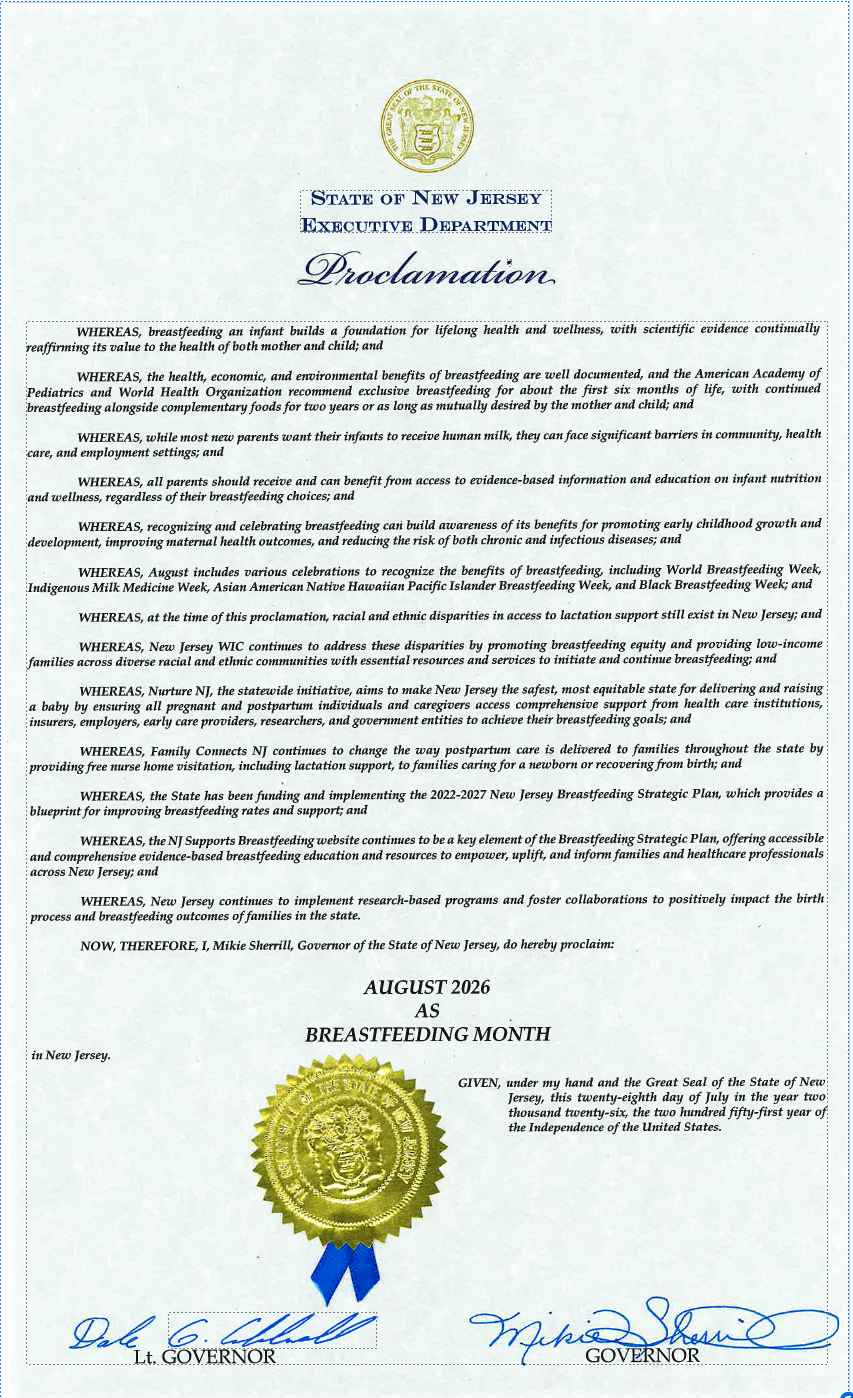
Around the world, the first week of August is World Breastfeeding Week (WBW) and the month of August is also recognized as National Breastfeeding Month both in the United States and New Jersey. This year’s international WBW theme, “Breastfeeding for a Sustainable Start in Life: Strengthen What Works”, reminds us to bolster proven practices, policies, and support to create environments in which all families can meet their lactation and infant feeding goals. One of those proven practices is supporting breastfeeding in the workplace.
Having to return to full-time work after a baby’s birth makes continued breastfeeding more difficult. Separation from their baby means parent workers need to express milk at intervals throughout the day to provide milk to caregivers and to maintain robust milk supplies.
Research has shown that employer support can result in an almost two-fold increase in the likelihood of the employee exclusively breastfeeding. Fortunately, New Jersey state law provides strong protections to employees who wish to continue feeding their babies their milk after they return to work.
The New Jersey Law Against Discrimination (LAD) requires employers to provide reasonable lactation accommodations to breastfeeding and lactating employees including, at a minimum:
- Reasonable break time to express milk; and
- A private place to express milk (pump) other than a bathroom stall, that is close to the employee’s work area.
Under the LAD, employers must also grant other reasonable breastfeeding-related accommodations. For example, an employee may need changes to their work responsibilities, uniform or schedule to support their pumping needs.
The LAD does not restrict these rights by the infant’s age. These rights must be provided unless the employer can show that doing so would cause undue hardship. In addition, workers cannot be punished or be treated unfairly or unequally for seeking these accommodations.
Importantly, the LAD applies to all New Jersey employers of any size. The LAD also protects full-time, part-time, and seasonal workers. Employees who work remotely or are required to travel for work are also entitled to these rights. Only independent contractors and federal government employers are not covered by the LAD. Federal employees are entitled to similar workplace lactation rights under the federal PUMP Act.
Additional resources on New Jersey’s workplace lactation rights:
- NJ Supports Breastfeeding—Back to Work
- NJ Division on Civil Rights: Pregnancy--Breastfeeding, and Reproductive Rights in New Jersey
- Workplace Accommodations for Breastfeeding and Lactation (Also available in Chinese (Simplified) | Chinese (Traditional) | Gujarati | Korean | Portuguese | Spanish)
- New Jersey Breastfeeding Coalition—Breastfeeding and Employment