
Posted on March 19, 2026

New Jersey Task Force Releases Report Calling for Action to Safely Reduce Overreporting of Child Neglect
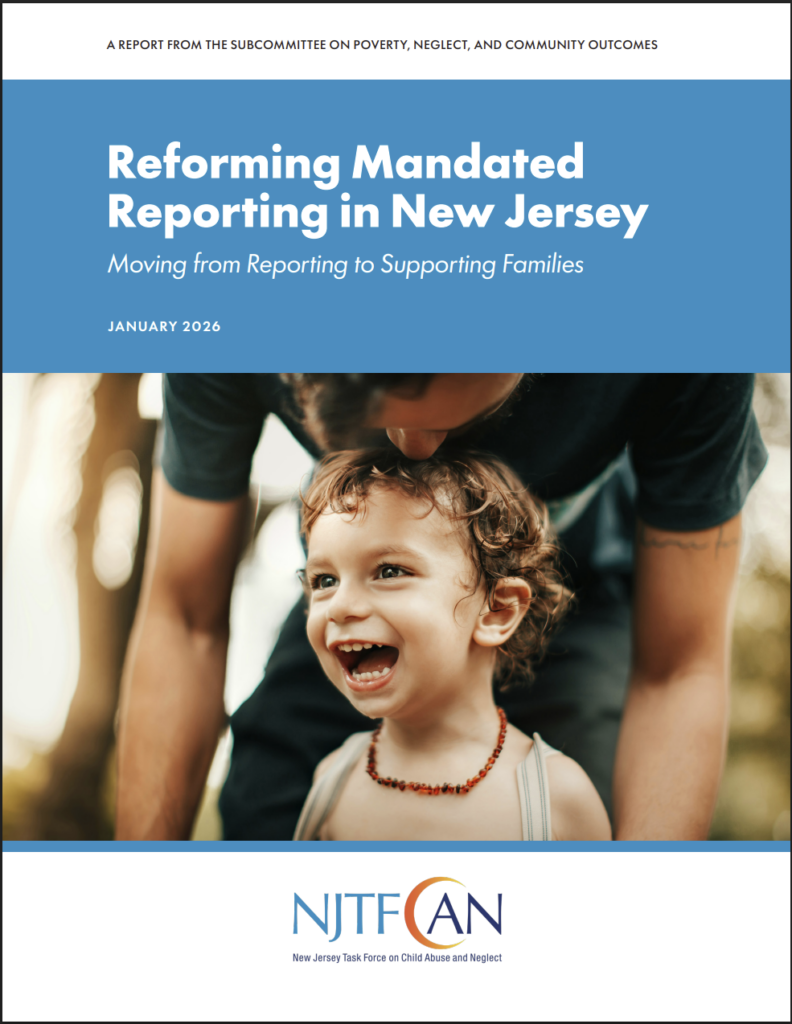
The New Jersey Task Force on Child Abuse and Neglect (NJTFCAN) has released a new report, Reforming Mandated Reporting in New Jersey: Moving from Reporting to Supporting Families, offering nine actionable recommendations to reduce unnecessary child neglect reports. It serves as a strategic roadmap for distinguishing between economic hardship and actual child endangerment, prioritizing family support over unnecessary state intervention.
When poverty is misidentified as neglect, vulnerable families are unjustly impacted. Mandated reporting is the legal requirement for certain professionals to report suspected child abuse or neglect. States differ in who they designate as mandated reporters. While some states like New Jersey require all individuals to report concerns, most commonly mandated reporters are social workers, healthcare professionals, teachers, child care providers, and law enforcement.
Mandated reporting aims to protect children from harm. Hundreds of reports are made daily to New Jersey’s child abuse hotline, but over two-thirds allege suspected neglect, not abuse. Fewer than 3% require system intervention by the New Jersey Division of Child Protection & Permanency. As a result, tens of thousands of families face unnecessary investigations, which can be more harmful than helpful. This issue is driven by the frequent conflation of poverty with neglect, reinforced by current liability rules and training requirements.
To address the rise in unfounded neglect reports, the New Jersey Task Force on Child Abuse and Neglect (NJTFCAN) formed the Subcommittee on Poverty, Neglect, and Community Outcomes. Its goal was to “safely shift from fear-based reporting toward supporting families within their own communities, by increasing the precision and accuracy of mandated reporting.” The subcommittee established three workgroups—Training, Liability, and Pilots & Innovation—comprising 46 members, including state partners, individuals with lived experience, advocates, community leaders, educators, and law enforcement.
The subcommittee developed actionable recommendations to reform mandated reporting, which the NJ Task Force on Child Abuse and Neglect approved in fall 2025. These are detailed in the report, Reforming Mandated Reporting in New Jersey: Moving from Reporting to Supporting Families. The report outlines nine recommendations to reduce unnecessary hotline reports by enhancing training on when and how to report. To read the report, visit https://www.nj.gov/dcf/providers/boards/njtfcan/.
The report examines how current reporting and response practices can unintentionally harm children and families by confusing poverty with neglect. Using national research, data, and lived experience, it provides a roadmap for aligning child welfare policy with evidence-based approaches that support family stability, child wellbeing, and community strength.
Key recommendations from the report include:
- Increasing the precision and accuracy of mandated reporting through statewide training that equips professionals with tools and knowledge to best support families.
- Assigning mandated reporting responsibilities to trained child-serving professionals, rather than requiring all residents or adults in New Jersey to report.
- Increasing awareness of the costs of overreporting on the child protection system and shifting toward procedures that prioritize supporting families.
- Addressing misuse of the reporting system by increasing penalties for false reports and revising practices related to anonymous reporting.
The NJTFCAN encourages policymakers, child-serving professionals, and community stakeholders to review the findings and participate in advancing these recommendations.
The Task Force emphasizes that reducing overreporting does not lower child safety standards. Instead, it ensures families receive appropriate help at the right time through the right systems. Children and families benefit when mandated reporters connect them to resources rather than referring cases rooted in poverty to the child abuse hotline.
Please read the full report, which is available at: https://www.nj.gov/dcf/providers/boards/njtfcan/
About the New Jersey Task Force on Child Abuse and Neglect and the Subcommittee on Poverty, Neglect, and Community Outcomes
The New Jersey Task Force on Child Abuse and Neglect (NJTFCAN) is a statutorily established, multi-disciplinary advisory body to New Jersey’s child welfare system, charged to study and develop recommendations regarding the most effective means of improving the quality and scope of child protective and preventative services provided or supported by the state government. ACNJ President/CEO Mary Coogan co-chairs the Task Force with DCF Commissioner Christine Beyer.
The NJTFCAN Subcommittee on Poverty, Neglect, and Community Outcomes was convened in 2023 to examine and develop recommendations to address ways in which the current operation of the child welfare system in New Jersey conflates poverty and neglect.